
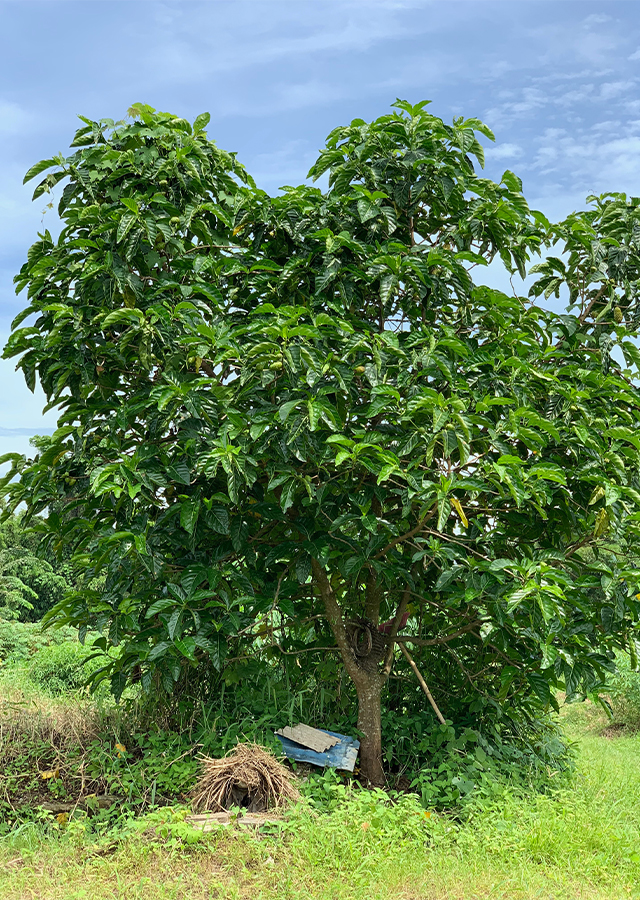
Noni Tree
Morinda citrifolia
Kingdom
Plantae
Division
Pteridobiotina
Class
Magnoliopsida
Order
Gentianales
Family
Rubiaceae
Genus
Morinda
Plant Description
Morinda citrifolia or the noni tree is a tropical plant that can grow up to about 3–8 meters. This tree has a woody stem, large glossy green leaves, and small white flowers. This plant grows easily in tropical climates like Indonesia and is often found in backyards or gardens.
Tree Benefits:
- Noni leaves are often utilized as traditional medicine to help relieve inflammation and reduce fever.
- The bark and roots are sometimes used in traditional herbal medicine.
- Provides shade and beautifies the garden because its leaves are dense and green throughout the year.
Estimated Carbon Absorption
Data based on number of plants
Total Carbon (kg/tree)
775,815
Total Carbon (ton/ha)
0,001
Total CO₂ Absorbed
0,002 ton
What is Carbon Estimation and Why is it Important?
Carbon stock is the amount of carbon stored in an area, mainly in plants, soil, and other green elements. In the context of parks, carbon stock shows how much a park contributes to 'absorbing' carbon dioxide (CO₂) from the air through natural plant processes like photosynthesis. The absorbed carbon is then stored in stems, leaves, roots, and soil around it.
Carbon estimation refers to the estimated amount of carbon absorbed and stored by vegetation in a park. This calculation usually uses scientific methods based on plant species, tree size, area, and vegetation density. In other words, carbon estimation helps us understand a park's contribution to reducing air pollution and climate change impact.
Term Explanation
- CO₂ Absorbed : Estimated amount of carbon dioxide absorbed by the plant.